Showing posts with label Firefox. Show all posts

Touch Friendly Firefox for Windows 8 is Ready for Testing

Mozilla has been working on a touch optimized version of Firefox ever since Microsoft revealed Windows 8 and the special version of Internet Explorer designed for Windows Start Screen interface. For a while, this touch friendly version of Firefox for Windows 8 made especially for tablets was available on the Nightly channel. Yesterday, Mozilla pushed this version out of Nightly and into Aurora, which means that this particular build is more stable than the former and while it’s not exactly ready for consumers, it’s good enough to be used by people who aren’t technically savvy or are developers and bug hunters.

To test Firefox Aurora in Windows 8, you need to make sure it is the default browser. If this is the first time you are installing the Aurora build, you will be asked whether you want to set the browser as the default. Choose yes. If you already have Aurora installed but it is not set as your default browser, then follow the steps below.
  1. Right-click on the Start button and on the context menu, click on “Control Panel”.
  2. On Control Panel, click on Default Programs.
  3. Next click “Set your default programs”.
  4. Allow the programs list to load. When it does, select “Aurora” and then click on “Set this program as default”.
Alternatively,
  1. Open Firefox Aurora on the desktop.
  2. From the Aurora menu on the top, click on Options.
  3. Click on Advanced and then switch to the General tab. Now click on the button that says “Make Aurora your default browser”.

Firefox 26 Aurora

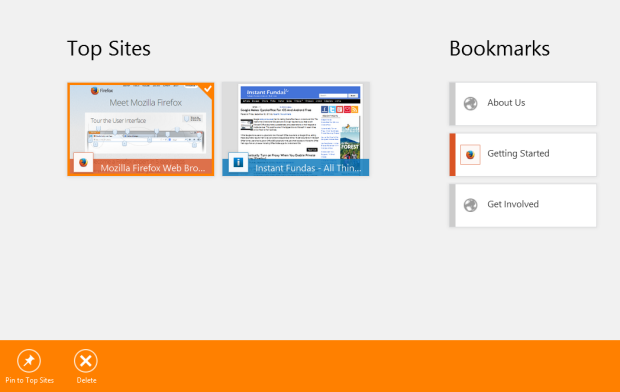
Firefox 26 Aurora is a lot different than Firefox is for desktop, which is expected. Yet, it doesn’t make users feel handicapped or helpless that Internet Explorer for Windows 8 seems to make. For instance, you still have access to the start page where you can find your most visited pages or pin your favorite sites. Your bookmarks and Recent History is also available from the same page.
firefox-26-aurora-4
Do note that, Firefox in Windows 8 mode doesn’t share bookmarks, history and passwords with the desktop version. To share them, you need to enable Sync.
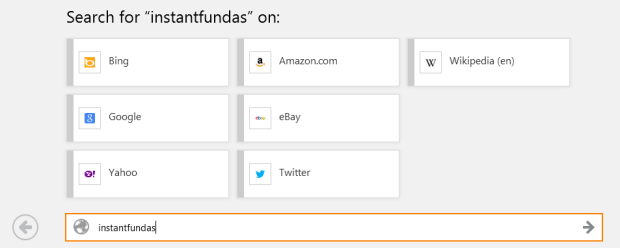
From the toolbar, you can bookmark a page, pin a page, search within a page, or view the page on the desktop browser.
firefox-26-aurora-1
firefox-26-aurora-3
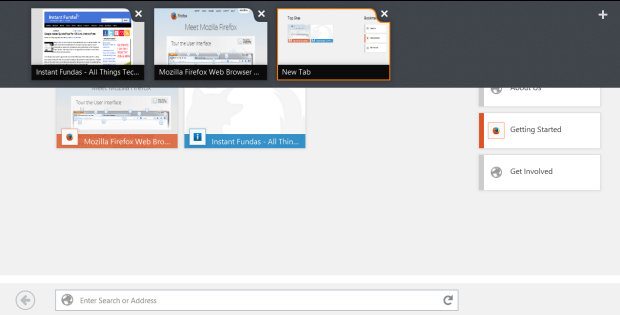
To access the tab bar, all you need to do is right-click anywhere inside the browser window.
firefox-26-aurora-2
For a full list of changes in Firefox 26 Aurora, and not just Firefox for Windows 8, see this page.
Read more ...

Firefox Beta Gets Per Window Private Browsing and New Download Manager

Mozilla has just released the first beta of Firefox 20, that includes a new feature for private browsing, a new experience for downloads, and a handful of exciting developer features.
The Per Window Private Browsing has been finally pushed to the Beta channel. The new feature, which made its first appearance in the Nightly in December last year, allows users to open private windows without having to close their entire browsing session first. Currently, Firefox users who want to launch a private browsing session have to close all their current windows. Not any more. Now it is possible for users to view a Web page in private browsing mode and regular browsing mode simultaneously, in two separate Firefox windows.

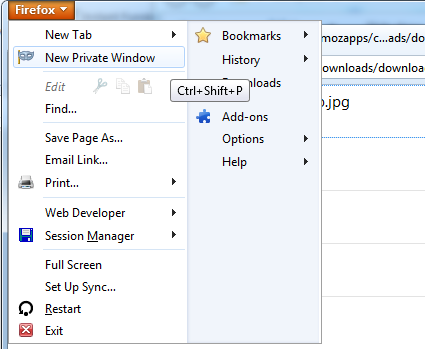
A new private window can be opened from the Firefox orange menu. You can also right click on any link on a page and choose “Open Link in a New Private Window”.
firefox-private-browsing
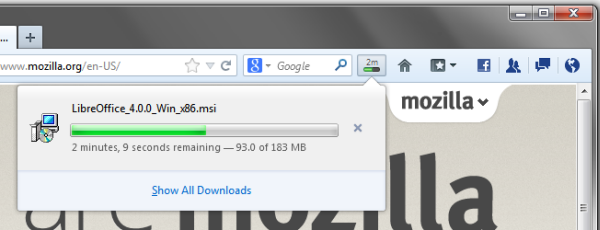
Mozilla also updated the download manager to make it less irritating. When you start a new download, Firefox used to open a separate download window. In the latest beta, the download manager has been integrated right into Firefox toolbar so that you can view and monitor download progress without having a separate download window in your face.
Download-Manager
The download window still exist and can be opened by clicking on the “Show all downloads” link in the pop-up. But it is now part of the Library along with Bookmarks and Tags.
Firefox beta also includes a plug-in warning system that will warn you when a plug-in stops responding for more than 45 seconds, so that you can restart the plugin rather than restarting Firefox, allowing you to keep browsing the Web, uninterrupted.
Other changes include a new HTML5 DOM API that allows the browser to capture local camera and/or microphone streams directly, without the need for third party plugins, CSS Flexbox, a developer toolbox, providing quick access to popular developers tools such as the Web Console, Debugger, Inspector and Style Editor in one handy window, and support for Canvas Blend Modes.
Read more ...

How to Remove Profanity, Swear Words or Foul Language From Webpages

Foul language, swearing, cursing, cussing and bad words in general are commonly seen on the web. Just go to any website and read the comments at the end of an article, or visit YouTube or any discussion board or social networking site and you will almost always come across vile postings full of hate and hostility and lack of respect in general. If you hate profanity and want to get rid of them from your browser, either for yourself or to create a friendly environment for your kids, this article will guide you how and from where to begin.

Filter Profanity by Keywords

The best way to remove profanity on the web is to filter them using a blacklist of known bad words. In Chrome, you can install the Simple Profanity Filter that replaces user defined words with asterisks such as ****. You can configure the filter to show the first character of the blocked word and hid the rest, in case you are curious what the blocked word is. For instance, a filtered word will show up as F****.

The extension comes pre-installed with a small selection of cuss words that should do the job initially. You can make the filter more effective by adding your own keywords.

simple-profanity-filter-

Firefox has one of the best profanity filters made for browsers - ProCon Latte Content Filter, which can be used not only to censor inappropriate language but restrict access to websites that contain questionable content. When ProCon Latte detects objectionable words on a webpage, it blocks the page and displays a notification. You can then allow Firefox to display the page temporarily or add the domain to the whitelist to prevent ProCon Latte from blocking the page in future. Once the page loads, ProCon Latte will filter swear words and replace them with garbage characters such as !@#$%^&* (this can be changed in the options page).

procon-latte

You can disable Content Blocking altogether, and stick to only Profanity Blocking. This way, webpages are not blocked but profanity is censored. ProCon Latte supports blacklist, block websites list, and whitelist.

If you love Greasemonkey scripts, install the Profanity Filter userscript. The Profanity Filter will block objectionable words based on a list of keywords and replace them with asterisks. The script comes with a large selection of keywords and you can add or remove them by directly editing the script.

If you want to take web cleansing a step further, install tinyFilter for Chrome. Rather than hiding the bad words, this extension disables access to the entire webpage. This is the default behavior and can be easily overridden by disabling “content blocking” from the extension’s option page. Doing so will change tinyFilter to a less aggressive profanity filter. tinyFilter is also based on keywords and comes with a self-updating blacklist. You can also add your own keywords.

tinyfilter

tinyFilter’s content blocking is useful when you want to block pornographic material and adult websites. Pages can be blocked by URL too.

Remove Comments Containing Profanity

Since the source of all foul language on the web is user-generated content, mostly comments, you can leave the articles alone and target only on offensive comments.

Comment Snob for Firefox and Chrome hides undesirable comments from the web based on the following rules:

  • Number of spelling mistakes
  • All capital letters
  • No capital letters
  • Doesn't start with a capital letter
  • Excessive punctuation
  • Excessive capitalization
  • Profanity
  • Filtering on custom words and phrases

You can choose which rules you want to enforce.

comment-snob

Blocked comments are hidden under a collapsible section. A click on the Show link reveals the hidden comment.

Comment Snob comes with support for YouTube by default, but you can add support for many other sites by installing Comment Snob rules for Yahoo! News, Break.com, Mashable, Hacker News, Fark and Reddit.

CommentBlocker for Chrome goes one step further and hides all comments on all websites regardless of whether they contain profanities or not. The extension hides the entire comments section under an overlay, but if you wish to see them you only have to click on the overlay once.

The identically named (but from different developers) CommentBlocker for Firefox functions just like its Chrome counterpart - it blocks all comments. When comments get blocked an icon appears inside the address bar which you can click to toggle the comments on and off. There is support for blacklist and whitelist for websites, letting you decide what to filter out and what not to.

Do you get bothered by foul language? How do you manage or react when you encounter them on the web?

Read more ...

Firefox Modern App for Windows 8 Arrives in Nightly

The Modern UI version of Firefox has made it appearance in the Nightly channel of the browser last Tuesday. The Firefox Modern version, which is the first third-party browser to be released in the Modern/Metro interface exclusively for Windows 8, was first promised in October last year. The browser is still in the early development stage and there is plenty of work to do, as admitted by Asa Dotzler, Firefox desktop product manager, but the company confirmed that the browser is now stable enough for regular testing by interested Windows 8 users.

If you are using Firefox Nightly that is configured to auto-update, you already have the Modern version, but to experience it you’ll need to have Windows 8.

firefox-metro

The Nightly version 21 is available both as a regular desktop program as well as a Modern app, and is bundled together in a single installer. After you download and install Firefox Nightly 21 (and above) you should see the Modern app tile to the far right end of your Windows Start screen. When you install the browser, make sure you set Firefox as your default browser. If not, the desktop version of Firefox will launch instead when you click on the Nightly icon in your Start Screen. This is a limitation Microsoft has purposefully included into the operating system.

At present, Firefox Modern is a fairly simple affair – the browser launches in a chromeless browser window similar to Metro IE.

firefox-metro-1

The start page consist of a list of Top Pages you visit, your Bookmarks and your browsing History. The tab bar is hidden by default but can be revealed by right-clicking on the page or by swiping your finger from the top to bottom.

An orange bar at the bottom lets you access the Downloads page, bookmark the current page, pin it, zoom in/out of it, and search for text on the page. Except the zoom feature, everything else seems to be working. Although the browser itself is not quite stable as the developers would have liked. I had to reinstall it twice before I could even use it.

firefox-metro-2

The Options page, which can be accessed from the Settings button in the Charms bar in the right edge of the screen, shows a few settings including Firefox sync and a few Privacy options. You can also decide whether you want the browser to show the start page or the last session when launched, and if tabs should be visible at all times.

firefox-metro-options

Usually, a Firefox build stays in the Nightly channel for six weeks or so before they are promoted to the Aurora channel followed by the beta channel, remaining six weeks in each channel. Assuming the developers stick to the schedule, we can expect Firefox Modern version to hit stores somewhere in May or June.

Another browser maker that is reportedly working on the Modern port is Google for their Chrome browser, but it is not clear when this version will be released, if at all. Right now the only stable Modern browser for Windows 8 is IE10.

Read more ...

How to Customize Firefox’s Orange Menu

Open Firefox’s menu by clicking on the orange button at the top-left corner and look at it. Don’t you think there is plenty of room for additional options? For a menu that is such strategically placed within the browser interface, it is woefully underutilized. Just look at the empty space in the bottom right. Good news is, you can customize this menu to your own liking and even add new buttons and other menus to it.

To edit Firefox menu, first install the Personal Menu add-on for Firefox. Restart Firefox and then open the Firefox menu and click on the “Edit this menu” option.

personal-menu1

The Personal Menu Options dialog box will open. Here you can see several items listed on the left. These are items that are available for addition to the menu. On the right is a copy of the current Firefox menu. The copy changes to reflect the modification you make to the menu, so that you can see how the menu will look before you actually apply the changes.

personal-menu-options

To add items to the menu, simply select the item you want and click on the green “+” button. To remove items from the menu, use the “-“ button. To rearrange items on the menu, click the blue up/down buttons.

You can create new sub menus and move items inside them, split existing sub-menus into two or more and move items in and out of them. Below are some examples of customized Firefox menu to give you an idea of the kind of customization that is possible.

personal-menu-example

personal-menu-example2

Personal Menu also adds a bookmark menu and a history menu to Firefox’s toolbar. You can further customize these menus from Personal Menu Options dialog box. Customization options include changing mouse behavior (middle-click and right-click actions), menu position and a few others.

Read more ...

Protect Your Privacy When Using Firefox in Presence of Others

Should someone arrive unannounced at your desk and ask you to show something in Firefox or want to borrow it for a while, will you comply? Are you sure your browser history is clean and there isn’t something you shouldn’t be viewing? Nothing is more embarrassing when you have people around, and you start typing an address in the URL bar and Firefox autocompletes it with the most inappropriate address from your bookmarks or history. How you wish you had time to delete your browser history before starting, or that you had never saved that website to Firefox’s bookmark.

You can avoid such embarrassments in future by making a small preparation – install Presentation Mode.

Presentation Mode is a simple add-on for Firefox that protects your privacy by allowing you to temporarily disable autocomplete, hide past searches, disable the New Tab Page and collapse the bookmarks bar before you start giving a presentation. This can be done with a simple click of a button and at short notice.

presentation-mode

When you are in the middle of a browsing session, and someone arrives unexpectedly and you need to show something in your browser, just click on the red icon in the extreme right of the add-on bar to start the Presentation Mode. When this mode is enabled, Firefox saves all active tabs and closes the current browsing session and starts a new one. The new session has the following privacy settings enabled:

  • Autocomplete in the address bar is disabled. This prevents Firefox from showing your browsing history and bookmarks. Be aware that this extension doesn’t delete history which can be viewed from the history menu.
  • New Tab Page that reveals your top visited sites when a new tab is opened is disabled.
  • The bookmarks toolbar is automatically collapsed.
  • Clears the last searched text and disables search suggestions in search box.

To exit Presentation Mode, click on the button again and the previous browsing session is restored and privacy restrictions lifted.

Read more ...

Self-Destructing Cookies: Delete Cookies When The Page is Closed [Firefox]

Cookies aren’t evil. They are needed by websites to remember user’s preferences and the state of their activity on the website. This can include clicking particular buttons, logging in, or a record of which pages were visited by the user even months or years ago. This is legitimate tracking and necessary for websites to maintain a certain degree of usability. It’s the third-party cookies that advertising companies use to track users across multiple sites in order to target advertisements that bring bad press. These cookies are often persistent in nature, meaning that they stay active on the system even after the user session has terminated and continue to monitor the user’s movement across the web. The ‘Do Not Track’ policy and cookie laws by the European Union are the result of such intrusive tracking.

Third-party cookies can be blocked by most browsers to increase privacy and reduce tracking by advertising and tracking companies without negatively affecting the user's Web experience. Most browser also have a setting where they will automatically remove all temporary files, browser history and cookies when the user closes the browser. This allows users to keep one browsing session separate from the other. However, until the browser is closed, the cookies remain active and continue tracking the user.

Self-Destructing Cookies is a new add-on for Firefox that automatically deletes cookies when they are no longer used by any of the open browser tabs. This happens when the page or the tab is closed, or the user exist the page by clicking on another link.

self-destructing-cookies2

By default, Self-Destructing Cookies will wait for 10 seconds to see if the cookie is reused and if not, it’s flushed out of the system. The “Grace period” is necessary on websites that track user sessions using cookies, such as email providers, Facebook or any sites that require login. Reducing the time period to zero will cause these sites to stop functioning, and you will require to re-login every time you click on another link on the page. Third party cookies such as those from advertising companies that are not necessary gets deleted.

Another advantage of automatically deleting cookies is that you are automatically logged out of the website, in case you forgot to.

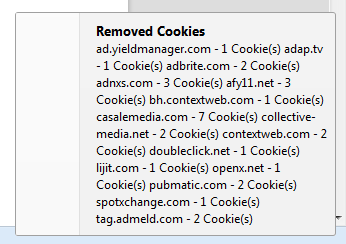
A notification pops open at the bottom right corner of Firefox whenever cookies are removed. If that gets too distracting you can disable notifications from the add-on’s Options page.

self-destructing-cookies

Now there maybe some sites whose cookies you want to preserve, for example websites where you want to remember your login information. You can whitelist these sites using Firefox’s already available cookies exception list.

This list can be found under the “Privacy” tab in Option. Under the “History” heading, change “Firefox will remember everything” to “Use custom settings for history”. Then you can see the Exceptions button.

self-destructing-cookies-exception

Click on it to “Allow” the sites.

Read more ...

Mark Important Tabs in Firefox

Sometimes when you open too many tabs in Firefox and you need to switch from one to another, you often have to hunt for them. Important Tabs is a new add-on that solves this problem by allowing you to mark some tabs as more important than others. Important tabs gets highlighted from the rest so it becomes easier to locate them.

To mark a tab as important, all you have to do is right click on the tab in the tab-bar and choose “Important tab”. This turns the tab title color from the default black to blue. To unmark a tab, right-click on the tab again and uncheck the “Important tab” option.

important-tabs

Keep in mind, the tab which you want to mark as important must be opened first. You cannot point the mouse pointer to an unopened tab in the tab-bar and mark or unmark it. The “Important tab” option that you see in the menu is only for the tab/page that is currently open and visible in the browser window. It doesn’t matter which tab you point the mouse pointer to. This is not immediately apparent, so you might end up marking the wrong tabs.

important-tabs2

To unmark all tabs, choose the “Forget importance” option. Another handy option in the tabs menu allows you to close all un-important or unmarked tabs at once.

This is a restartless add-on so you can check it out right away.

via Firefoxfacts

Read more ...

Per-window Private Browsing Comes to Firefox Nightly

Reports of an upcoming feature - per-window private browsing in Firefox, has been floating around the web the past few days. Today, Mozilla announced that per-window private browsing is indeed coming to Firefox and the first builds for testing is available in the experimental Nightly version of the browser. No time frame has been given but it’s expected that the new feature will find its way into the stable channel early next year.

Per-windows private browsing allows users to open private windows without having to close their entire browsing session first. Currently, Firefox users who want to launch a private browsing session have to close all their current windows. Mozilla revealed that per-window private browsing is one of the most requested features for Firefox, and it took the developers no less than 19 months to fix it.

Private-Browsing

The new feature now allows users to keep their existing Firefox window unaffected when they open a new private window. Additionally, users are now able to open links in a private window by right-clicking and choosing the “Open Link in New Private Windows” option from the context menu.

To try it out for yourself, download and install the latest Nightly version of Firefox from this page.

Read more ...

Facebook Messenger for Firefox Now Available

Mozilla today announced that it has started experimenting with a new social feature inside the Firefox web browser via the Social API announced in July, and the first to join is Facebook. The Social API will integrate social features directly into the Firefox browser. Things like sharing, chatting and keeping tab with new updates will all be possible from the sidebar without having to keep Facebook open in another tab. While Facebook integration using third party add-ons is already possible this is the first time a browser company has tried to integrate social media natively into their browsers. (Well, there is Rockmelt).

With Facebook Messenger, users will be able to access Facebook chat directly from the sidebar without having Facebook open in a tab. Users also get the ability to share the page they’re visiting with a single click in the address bar. Additionally, Facebook Messenger will alert users of new notifications, updates and emails. Needless to say, Facebook Messenger is for those whose lives practically revolve around Facebook, but Mozilla expects more services to join in shortly.

facebook-for-firefox

“The Social API isn’t provider-specific, though. We want to build a social standard for the Web, much like we did with our work on OpenSearch,” wrote Mozilla in their blog.

To get started just upgrade to the latest Firefox Beta and then visit this link.

When Facebook offers you Firefox integration, click on the “Turn on” button and you should see a set of Facebook icon in the browser’s toolbar. Click on it to enable the sidebar.

Use the login button on Sidebar to sign into Facebook and the sidebar will populate with all your friends. The sidebar is similar in looks and function to the sidebar in Facebook. The upper half showing latest updates from friends and the lower half functioning as a messenger.

The Facebook buttons in the toolbar allows you to toggle view of the sidebar and desktop notifications. Friends request and all notifications are showed right on the icon.

“We think we’ve built something really cool,” Mozilla prides itself. Facebook fans should be pleased with the new update.

Read more ...

CloudMagic Adds Lightening Fast Search to Gmail, Twitter, Facebook, Dropbox and More

CloudMagic is a unified search engine for your personal data in the cloud. It lets you search across a dozen different services including Gmail, Facebook, Twitter, Dropbox, Evernote, and more through one simple search box, preview results and read emails and social media updates without leaving whatever you are doing.

CloudMagic is available as browser extensions for Chrome and Firefox, and also as a standalone app for Android and iOS devices. Here, I‘ll be reviewing the Chrome extension.

cloudmagic2

After installation, click on the CloudMagic button in the toolbar and signup for an account on CloudMagic. Then simply connect your social accounts using OAuth. At the time of this writing, CloudMagic supports the following accounts:

  • Gmail and Google Apps
  • Facebook
  • Twitter
  • Microsoft Exchange
  • Office 365
  • Evernote
  • Dropbox
  • Box
  • Google Docs, Calendar and Contacts
  • Google Chat
  • iCloud
  • AOL
  • Mail.com
  • GMX

Once you add your accounts, CloudMagic starts indexing your data. Indexing time will vary depending on how big your account is, but recent email are almost instantly available for search. The results are organized and displayed by source (Inbox or Post and updates or events) and you can also filter results by messages, people, docs and events from Google Calendar. CloudMagic also supports the same advanced search operators as available in Gmail such as “from”, “to”, “subject”, “has:attachment” etc.

cloudmagic3

All operations can be performed from within a pop-up window. Inline results and previews are displayed within the same window. When you aren’t searching, that is, the default pop-up window reveals the latest emails you’ve received in your inbox, the latest updates in Twitter and Facebook, the latest files uploaded to Dropbox and Google Docs and so on. You are able to fully browse, search and read your emails and social media updates from within this little window.

The most impressive thing about CloudMagic is the incredible speed with which you get results, and considering how slow Gmail’s interface has become in recent months, CloudMagic is a must have tool for anybody who wants to be at the top of their inbox and social media accounts.

Read more ...

3 Great Firefox 15 Features You Should Enable Right Now

firefoxMozilla debuted Firefox 15 just a few days ago, and unlike most of the recent releases, version 15 includes some major changes. The most notable among them is an improvement in the way the browser uses and releases memory. Mozilla has been working to fix the memory leak problem that has been plaguing the browser for years, and although I won’t hold my breath, Firefox 15 is showing appreciable improvement. According to the organization, the developers have managed to patch Firefox 15 solving the most common add-on leaks. The best part is that add-on developers don't have to do anything as the fix applies to all add-ons.

While most changes are performance based, there are a few new features that users can benefit from during the day to day use of their browser. You won’t see them because they are disabled by default. And that’s for good reason – they are not ready for prime time as the developers feel there are still a few issues that needs to be ironed out before the new features can be released to the masses. If you are willing to accept the occasional hiccups that you might encounter on the way, here are 3 hidden features that you should enable in Firefox 15 right away.

Native PDF Viewer

firefox-native-pdf

Mozilla has been working on PDF rendering functionality since first introducing pdf.js a year ago. Initially available as a separate PDF Viewer add-on for the browser, pdf.js displays PDF files in HTML5 with JavaScript using Canvas and SVG APIs. The PDF viewer functionality is now built-in by default and its user interface was refreshed several times during the development stage.

How to Enable?

Go to about:config, search for "pdfjs.disabled". Double click on it to change the value to "false." Restart Firefox for the changes to take effect.

Click-to-play Plugins

firefox-click-plugin

Click-to-play plugins disable plugins by default, such as embedded Flash player, so videos in YouTube will not autoplay as soon as the page loads; you will have to click the Play button to load the Flash player. This is a good thing as it prevents any Flash content from auto playing.

Both Google Chrome and Opera has had a "click-to-play" plugins for more than a year now. Now Firefox has one as well.

How to Enable?

Go to about:config, search for "plugins.click_to_play". Double click on it to change the value to "true”. Restart Firefox for the changes to take effect.

Options in Tab

firefox-tab-options

Taking a cue from Google Chrome, Mozilla developers have included an option in Firefox 15 that allows users to view the browser’s Options window in a tab instead of in a separate window. Peculiarly, only the Options window is affected by the change; the Downloads, Bookmarks and History still open in their own windows.

How to Enable?

Go to about:config, search for "browser.preferences.InContent". Double click on it to change the value to "true”. You don’t to restart Firefox for the changes to take effect.

Read more ...

FVD Speed Dial With Online Sync for Firefox and Chrome

FVD Speed Dial With Online Sync for Firefox and Chrome

keypadAll new web browsers utilizes the empty space on a new tab to display a row of thumbnails of your most recently and frequently visited web sites. Opera calls this the Speed Dial, after the speed dial feature found in most phones, while other browsers simply call it the ‘new tab page’. In Firefox and Chrome, the new tab page is not very customizable. The extent of customization that is allowed on the new tab page depends on the browser you are using. In Firefox you can arrange the order in which the thumbnails appear and pin select sites so that they are always available. In Chrome, you can arrange the thumbnails but you cannot pin sites. This is why third-party speed dial/new tab page extensions are very popular among Chrome and Firefox users. However, they still lack the ability synchronize your speed dial across all your computers and devices. Currently, the only speed dial extension that supports this is FVD Speed Dial.

The ability to sync online is just one of the many perks of using FVD Speed Dial. This add-on is highly customizable and supports a range of features like custom backgrounds, custom dials, organized groups, most visited dials and more.
fvd-speed-dial
fvd-speed-dial-chrome
Initially, FVD Speed Dial will display your most visited websites, but you can replace the tiles with your preferred websites. The extension also lets users group sites into multiple speed dial pages and quickly switch from one page to another. For instance, you can create groups for social networking sites, blogs, news and whatever you find useful. Also available is a list of most visited sites, a list of recently closed tabs and a recover session button that lets you recover your last browsing session, that is, the pages that were open when you closed Firefox the last time.
Options for customizing the appearance of the speed dial page are plenty. You can set everything from dial size, dial opacity, background colors, background images, fonts, font size, and even minute things like whether or not to show the URL below each speed dials.
FVD Speed Dial for Firefox
FVD Speed Dial for Chrome
Other Features
  • Block by URL or Domain. This feature allows you to exclude unwanted URLs from appearing in your most visited Speed Dial group.
  • Background templates (similar to wallpapers in Windows) in browser window.
  • Mouse gestures for switching between sped dials and various viewing modes.
  • Four thumbnail sizes: Big, Medium, Small, List (just a list for those who prefer a compact view)
  • Several modes for setting the background image: Fill, Fit, Stretch, Tile, Center same as in Windows.
  • Activate or deactivate Flash, Silverlight and Java Script when creating a screenshot for the Dial.
  • Customizable page opening mode in the Speed Dial: in the current tab, in a new tab (Hotkey: Ctrl+Click), in a background tab (Hotkey:Ctrl+Shift+Click).
  • Customizable number of rows in the Speed Dial. Auto mode available.
Read more ...

Comodo IceDragon: New Browser Based on Firefox with Enhanced Security

Popular security software developer Comodo has developed a Firefox re-mix with focus on improving the default security features offered on Mozilla’s creation. Called Comodo IceDragon, the new browser is named similar to Comodo Dragon, their implementation of the Chromium browser with potentially privacy-compromising features removed. Comodo IceDragon is built on the Mozilla browser core and combines the basic functionalities of the original code with Comodo’s security features.

In this first release, the browser includes just two basic security features - Comodo Secure DNS and Site Inspector. Comodo Secure DNS is a DNS lookup service that employs malware detection and cloud-based scanning aimed to prevent malicious, harmful and scam sites from loading in your browser. The Site inspector is a malware scanning and blacklist monitoring service for websites. The Site inspector tool integrated into Comodo IceDragon is, however, a demand only scanning service. It doesn’t proactively protect the user from visiting malicious websites even if the website URL is blacklisted under Comodo Site Inspector.

icedragon1

icedragon2

Comodo IceDragon also includes a social sharing button that allows users to quickly share links on different social networks such as Facebook, Twitter and LinkedIn. The social sharing button is readily visible in the toolbar next to the Site Inspector button. Thankfully, there is an option to hide both the buttons.

icedragon3

Aside from the black and blue hues and some visual differences, Comodo IceDragon’s interface is identical to Mozilla Firefox. Users can enjoy the same sort of flexibility and customization as in Firefox, thanks to the support for Firefox add-ons. But users who take advantage of Firefox Sync to synchronize their data across multiple Firefox installation will have to sacrifice this functionality as Firefox Sync is absent in Comodo IceDragon.

Currently, there’s not much to write about Comodo IceDragon and the so called “security features” aren’t impressive enough to lure users from the massively popular Firefox browser. These features can be easily replicated in your current browser, no matter what, using system wide Comodo Secure DNS and any website blacklisting/malware scanning service. Firefox also doesn’t suffer from inherent privacy issues like Google Chrome does, which is one of the major selling point for Google Chrome clones such as Comodo Dragon and SRWare Iron.

The only selling point for Comodo IceDragon is security, but I see no reason why Firefox cannot be made more secure by third-party extensions.

Read more ...

How to Password Protect Firefox

Firefox has an option to set a Master password to protect sensitive information in your Firefox profile. However, this is limited to only protecting unauthorized users from viewing your saved passwords on websites. The master password doesn’t prevent users from launching Firefox or opening pages or accessing your bookmarks. It also doesn’t prevent users from accessing sites the browser is already logged in to. If you are looking to protect your entire Firefox profile or the browser itself and not just your passwords, we have two add-ons for the purpose.

Before you can use these add-ons, you have to setup a master password. For this, click on the Tools menu and then click on Options. In the Options window, click on the Security icon. Check the box “Use a master password” and then define your password.

firefox-master-pwd

StartupMaster

StartupMaster is a simple add-on for Firefox that asks for the master password at launch. Every time you start Firefox, you will get a password prompt as shown below, before the main window is displayed. If there is no master password set, the extension does nothing.

firefox-startupmaster

StartupMaster also fixes the annoying multiple password prompt issue. Once you are logged in with the master password, Firefox won’t bother you with password prompts when you attempt to view your saved passwords.

Master Password+

Master Password+ greatly enhances the security feature of the master password by allowing owners to completely lockdown the browser, set browsing time limits, boot out inactive users, and more.

What Master Password+ can do:

  • Ask for master password on Firefox startup
  • Exit Firefox when a number of wrong password attempts are made
  • Automatically lock browser when user is inactive for a certain period of time
  • Automatically lock browser after a certain time has elapsed even if the user is active. This is useful to enforce browsing time limits on the user
  • Block multiple password prompts when the user is already logged in
  • Use keyboard hotkeys to lock the browser, lock the active window or lock all windows

firefox-master-pwd-plus

Read more ...

PictuTools: Add Several Online Image Editing Tools to Context Menu [Firefox]

There are lot of online resources that lets you change, resize, crop and enhance images without having to learn to use heavy weights like Adobe Photoshop. Judging by the sheer number of such tools available, and the interest in acquiring them by the likes of Google it can be assumed that they are immensely popular. If you happen to use them often and have these sites tucked away in your bookmarks, and if you also use Firefox, you’ll find PictuTools pretty useful.

This add-on implements a context-menu which gives you quick access to several online services providing image manipulation tools such as Pixlr, BeFunky, SumoEditing, LunaPic and some more. You can convert images to a number of different formats including EPS, GIF, ICO, TIFF, PDF, TGA and WebP, perform reverse image search, view EXIF data, identify fonts and generate QRCodes among a few. It also offers a couple of image hosting sites to upload images for re-sharing, and an option to share images on Facebook and Twitter.

pictutools

When you want to edit an image you found online, simply right click on the image and choose the service which you want to use. This will take you to the service provider’s website with the image automatically uploaded and ready to work upon. At the moment the add-on only works on web images and not on local files on your hard disk.

The full list of supported services are given below.

Edit

  • BeFunky: BeFunky lets you apply photo effects, enhance, edit pictures and photos online. Cartoon, sketch, painting, pop art and more...
  • DrPic: Crop, Resize, Add Text, Special Effects, and Host your pictures online for free (with ads, in HTML/JS)
  • FotoFlexer: FotoFlexer lets you remove blemishes, change skin/hair color, morph photos and more! 100% free (with ads)
  • Iaza: Provides several conversion and effect tools by just clicking links
  • LunaPic: Edit Your Pictures with this basic but powerful online editor (ads, HTML)
  • Phixr: Online photo editor with no Flash required
  • Pixenate: Edit photos online, fast and easily - No plugins required.
  • PixLR: Flash-based online image editor.
  • PixLR (express): Flash-based online image editor, express/basic version
  • PixLR (o-matic): Flash-based online image editor which lets you apply different effects easily
  • SumoPainting: With SumoPaint you can Create, Share and Remix your Images.
  • Zygomatic: HTML-based editor. Resize, filters, sepia, crop, rotate, flip, effects
  • DeMotivational Poster: Meme Generator
  • pomf.me: Captioning tool
  • Ancient Look: Makes the image look like very old photographs
  • DynamicDrive Optimizer: Lets you easily optimize your gifs, animated gifs, jpgs, and pngs, so they load as fast as possible on your site.
  • SmushIt Optimizer: Smush.it uses optimization techniques specific to image format to remove unnecessary bytes from image files. It is a "lossless" tool, which means it optimizes the images without changing their look or visual quality.

Host

  • ImageShack: Host on ImageShack
  • Imgur: Host on imgur.com image hosting
  • OverPic: Host on overpic.het image hosting
  • PostImage: Host on postimage.org

Information

  • Exif viewer: View EXIF information for the image
  • MetaPicZ: Metadata and exif viewer
  • HTTP Viewer: See exactly what an HTTP request returns to your browser

Share

  • AddThis: Share to any of the supported websites by AddThis
  • Facebook: Share on Facebook
  • Twitter: Tweet this image
  • QR Code: Obtain a QR code which point to this image.

Similar

  • Baidu: Reverse image search using the Japanesse Baidu Service
  • Cydral: Reverse image search using Cydral
  • Google: Reverse image search using Google Images
  • TinEye: Reverse image search using TinEye
  • Yandex: Reverse image search using the Russian Yandex Service

Misc

  • Decode QR Code: Lets you decode a 1D or 2D barcode
  • i2OCR: Free online OCR that converts images into editable text.
  • WhatFontIs: Send the image to whatfontis.com to identify the font used.
  • WhatTheFont: Find what the type of font is used on the image
  • WhatsItsColor: Find the complementary and primary color of the image
  • ZoomIt: Converts your image to the Deep Zoom format, which lets you smoothly and efficiently explore the whole image, no matter how large.
Read more ...

Create Firefox Desktop Shortcuts for Specific Profiles

Firefox stores a user's preferences and data such as installed add-ons, saved passwords, history, bookmarks and others in a unique profile. The first time you start Firefox, it automatically creates a default profile and stores all settings associated with the profile within a special profile folder on your computer. Your profile folder is kept in a separate place from the Firefox program so that if something ever goes wrong with Firefox your information will still be there. It also means you can uninstall Firefox without losing your settings and you don't have to reinstall Firefox to clear your information or troubleshoot a problem.

It’s also possible to have multiple Firefox profiles, each containing a separate set of user information. Different profiles doesn’t necessarily mean different users. The same user can have more than one profile. For instance, you can have a profile for work and another for home. Each profile can have different sets of extensions and bookmarks and customization.

Previously I showed how to create and manage profiles in Firefox using the Profile Manager. Typically, you launch the Profile Manager by using the “–p” switch. That means, you launch Firefox by typing “firefox –p” in the Run dialog box.

firefox-profile-run3

Make sure that Firefox is not running. If it is open, exit it before running this command.

This will launch the Firefox Profile Manager.

firefox-profile-manager

From here you can create new profiles or choose an existing profile to start Firefox with. Now clearly, this involves too many extra steps. So here is a nifty trick.

Create a new shortcut of Firefox on your desktop or start menu. Right-click on the shortcut and then click on Properties.

Now on the Target filed, add “-p <profile-name>” at the end of the path. It should look something like this:

"C:\Program Files (x86)\Mozilla Firefox\firefox.exe" -p test

firefox-prop

This shortcut will open Firefox loaded with the profile named “test”. No need to go through the Profile Manager. You can do this for every profile you have created.

If you want to launch a different profile while one Firefox instance is already running, Firefox will just open a new window of the active profile. To fix this issue, add the parameter “-no-remote” to each shortcut’s Target field.

In our example, the Target field becomes:

"C:\Program Files (x86)\Mozilla Firefox\firefox.exe" -p -no-remote test

This trick fixes another annoying issue. When you try to open the private browsing mode, Firefox closes the current session. This is totally undesirable. But with the “-no-remote” parameter in place, you will be able to open Firefox private browsing mode and normal browsing together at the same time.

[via SumTips]

Read more ...

Tab Stacking Comes to Firefox, Brings Better Tabs Overflow Handling

Firefox has a peculiar way of handling tabs overflow that occurs when users open too many tabs for the tab bar to display properly. By default, Firefox pushes the extra tabs off the screen as new ones get spawned; the tab bar acting as a conveyor belt of sort. Arrows appear on both edges of the tab bar that allows the user to horizontally scroll the tab bar and access the out-of-screen tabs. Personally, I find this behavior disorienting.

It seems the accepted rule for handling tabs overflow, as followed by Opera, Chrome, Internet Explorer and the majority of browsers, is to resize them to accommodate new tabs. So I use the Noverflow add-on (now called Prevent Tab Overflow) to get this behavior in Firefox. This might not be the best way to handle tabs overflow but definitely better than the way Firefox does.

Another way to tackle tabs overflow is to use stacks, the concept introduced by Opera in version 11, where you manually drag and drop tabs over each other to create stacks. Chrome followed suit and added an experimental automatic tab stacking feature. Now tab stacking is available in Firefox through the Tab Stacking add-on.

Tab Stacking automatically stacks tabs on top of each other when the tab bar in Firefox becomes crowded. The add-on does this dynamically by stacking tabs on either far side of the active tab. The tabs goes in and out of the stack as the user changes focus from one tab to the next. There is no permanent stack of tabs. The image below will give you an idea of how this tab stacking works.

SNAG-0052

The active tab and the three tabs around it are in an expanded state. The tabs immediately next to them are collapsed in a stack. As you can see, there are two stacks on both end of the tab bar. When you change focus to a new tab, the stack changes.

SNAG-0053

The user can control the minimum width, which is the width of the active tabs and those immediately around it, and the width of the stacked tabs. There is another option to set the maximum width of the stacked tabs.

SNAG-0051

Tab Stacking is a proof-of-concept add-on in alpha version and may contain several bugs.

Related: 10 Best Tab Management Extensions for Chrome

Read more ...